Friday, September 24, 2010

Mono Jojoy Meets His Maker

Top FARC military commander and member of the directorate whose nom de guerre was Mono Jojoy a/k/a Jorge Brice~o, was killed in Colombia by the military after a concerted effort of several years to contain and isolate his command.

He literally grew up with the FARC. He was raised among the backwoods Stalinist bands that split from the Liberal Party rural guerillas of the Violencia period. Jacobo Arenas, the FARC's top ideologue and strategist, knew him from childhood, and became a life-long mentor and booster. Besides Communist indoctrination, a teenaged Mono Jojoy received plenty of on-the-job training as a guerilla fighter. By the 80's he had risen through the ranks to commmand large formations. Eventually he led the powerful East Front (Bloque Oriental) for years, Mono Jojoy was known as a top battlefield commander who in the 90's delivered strong blows to Colombia's military.
 

During the Zona De Despeje/Cease Fire period, he was all over the press and television, roaming around in a 4x4 with a posse that included many female guerillas.

In a country that has produced legendary (and telegenic) sociopaths like Pablo Escobar and Carlos Castano, Jojoy is right up there. He was a ruthless killer who ordered terror killings and kidnappings of thousands of Colombians. He was up to his neck in the drug racket the FARC ran, as well as their policy of keeping military and civilian hostages. Basically, he bears a lot of blame in the FARC's crimes of the past 30 years that have extended the conflict and ungovernability in Colombia

His death is a blow to the FARC. Directorate members - once considered invulnerable- have died like flies since 2007. Jojoy's reputation of a top commander leading the strongest guerilla columns will be extremely demoralizing to rank and file guerillas as well as middle and top leaders.

The noose also tightens on Cano, and the other directorate members. They have nothing to bargain with.

Friday, August 20, 2010

Daniel Ortega Places Himself All Over the Sandinista Revolution

via Two Weeks Notice: A Latin American Politics Blog
: Quote of the day: Nicaragua this story from the LA TIMES

At museum, Nicaragua president's favorite masterpiece is himself

Go to the Museum of the Sandinista Victory, and Nicaraguan President Daniel Ortega is everywhere. There he is on the northern front of the revolutionary war — and the southern front, and the western front.

Ortega has Forrest Gumped himself onto all the major battle lines of the struggle that dethroned dictator Anastasio Somoza in 1979, carried the Sandinista movement to power and radically changed Nicaraguan history.

As for all the other comandantes and major figures who shared in those events with similar or even more important roles?

"We have been erased," said Sergio Ramirez, the renowned writer and a member of the Sandinista government who served as vice president during Ortega's first term as president, from 1985 to 1990.

Ortega lost in 1990 — the first post-revolution democratic election — and lost three more times before finally returning to power by winning the presidential election in 2006.

The museum, a government-run project about a year old, is an open-air display that purports to illustrate the historic fight of the Nicaraguan people to rid their nation of decades of "gringo invasions" and other onerous shackles (as the young tour guide put it).

It is also but one example more of what many here see as the cult of personality surrounding Ortega.

In the age-old tradition of dictators including Kim Jong Il and Saddam Hussein (not to mention Somoza, whom Ortega did help depose), the Nicaraguan president has built a national homage to himself. Billboards dot this sprawling, haphazard capital with a larger-than-life picture of him alongside national heroes Ruben Dario and Augusto Sandino. Nicaraguans speak less of Sandinismo and more of Danielismo.


This reminds me of Stalin's image appearing in official pictures denoting October Revolution moments, where he had never been, or closer to Lenin.

Fact is, Daniel was the Sandinista's main polical tactician, his brother Humberto one of the main military tactician.

But, he was hardly a top battlefield commander during the main phases of the war which were the insurrection in 78 and the final offensive in 79, in any of the main fronts - Frente Norte, Frente Sur or Frente Interno.

And as a matter of policy after the triumph of the revolution the 9 commanders of the Sandinista National Directorate including Humberto and Daniel were co-equal in directing the affairs of the party, the army and the state. That was the result of a power sharing agreement, brokered by Fidel Castro, where the 3 main factions or "tendencias" within the FSLN would be represented at the top and theoretically co-govern equally. Even as president later in the mid-80's Daniel was still in theory accountable to the other 9 commanders.

Having spent years watching and seeing Sandinista propaganda on a daily basis, I can say that their message always focused on the party directorate and less on indviduals.

One of the main slogans of the FSLN, chanted by its cadres at rally's and propaganda was:
"Direcion Nacional Ordene!"

The only individuals they propped up in propaganda were dead - "martyrs".

The bottom line is that there was in the FSLN a tendency to not elevate individual commanders or politicians. Some of that due to them wanting to keep the peace internally, after the sectarian conflicts in the FSLN in the 70's. The other political one, was to avoid creation of a cult of personality that would bring back terrible memories by the Nicaraguan people. After all they had just risen up against Somoza 3.0 who ruled Nicaragua like the family farm for decades, continuing the dynasty started by 1.0 in the 30's.

Daniel Ortega placing himself everywhere in official memory is on the one hand misleading if not untrue. He was not in the main battle fronts when the fighting was going on -annoying former comrades who were there. Also annoying some other former Sandinistas because it is against their policy of subordinating individual personalities, and a dislike of personalism inherited from Somocismo.

Saturday, July 31, 2010

Brazil's Bolsa Familia - The Economist Article

Brazil's Bolsa Familia has been a great success in reducing poverty in Brazil thru payments to poor families, based on whether their children stay in school. The Economist finds that it is a rousing success in rural areas, and succesful though slightly problematic in urban areas


http://www.economist.com/node/16690887?story_id=16690887

Great Ayrton Senna Tribute From Top Gear

The excellent BBC Car Program Top Gear has a great tribute to Ayrton Senna.  What makes it stand out is how it focuses on Senna's technical abilities and talents as a driver, which sometimes gets overlooked in the mythology.   The Brazilian is presented warts and all. 


PART 2

Friday, July 30, 2010

Evo's Witch Doctor Gets Busted!!!

The so-called Aymara "Priest" who presided over Evo Morales' Presidential Inauguration  in Bolivia was found red handed with many kilos of some sort of cocaine derivative at his house.  Allegedly he was wearing his ceremonial robes.  The sorcerer apparently was casting an ancient Chapare spell of purification over about 500 pounds of cocaine base, when the police rudely interrupted the Amauta..

Valentín Mejillones, 55 años, fue quien entregó el bastón de mando a Morales cuando éste juró a su segundo mandado en enero en un rito andino celebrado en el mayor templo arqueológico del país.
Ostenta el título de amauta que en la religiosidad andina es el máximo líder espiritual. El martes en la noche, la policía allanó su domicilio en una barriada de la ciudad de El Alto, vecina a La Paz y lo sorprendió elaborando cocaína.
Llevaba su poncho ceremonial el momento de la detención. Fue detenido junto a su hijo y a una pareja de colombianos que no fueron identificados por la policía, según el informe del director de la fuerza antidroga, coronel Félix Molina.

Saturday, July 03, 2010

New York Times - Economies in Latin America Race Ahead

The New York Times, article discusses strong economic growth in several Latin American countries, despite the global recession. 

Strong demand in Asia for commodities like iron ore, tin and gold, combined with policies in several Latin American economies that help control deficits and keep inflation low, are encouraging investment and fueling much of the growth. The World Bank forecasts that the region’s economy will grow 4.5 percent this year.
Recent growth spurts around Latin America have surpassed the expectations of many governments themselves. Brazil, the region’s rising power, is leading the regional recovery from the downturn of 2009, growing 9 percent in the first quarter from the same period last year. Brazil’s central bank said Wednesday that growth for 2010 could reach 7.3 percent, the nation’s fastest expansion in 24 years.
After a sharp contraction last year, Mexico’s economy grew 4.3 percent in the first quarter and may reach 5 percent this year, the Mexican government has said, possibly outpacing the economy in the United States.
Smaller countries are also growing fast. Here in Peru, where memories are still raw of an economy in tatters from hyperinflation and a brutal, two-decade war against Maoist rebels that left almost 70,000 people dead, gross domestic product surged 9.3 percent in April from the same month of last year. 


And, then there is the obvious failure -
In Venezuela, electricity shortages and fears of expropriations caused gross domestic product to shrink 5.8 percent in the first quarter. But Venezuela, and to a lesser extent Ecuador, another oil-dependent country that lags behind its neighbors in growth, seem to be exceptions to a broader trend.

Sunday, June 27, 2010

Bolivia- Indigenous Challenges to Evo Morales

Miguel Centellas at Pronto has a post Bolivia: the indigenous/environmentalist challenge to Evo’s government

 Centellas is referring to the new controversies in Bolivia that have arosen from both indigenous and environmental groups using the language in the new constitution to challenge certain development projects (mostly hydrocarbons) that the Morales government wants.    


The bottom line is that the government is losing its grip on the indigenous movement. Attacking its leaders as agents of USAID (or US imperialism more broadly) and/or acting in line w/ the “extreme right” seems odd. During the 2005 campaign—and for several months later—Evo & MAS clearly raised the banner of indigenous political autonomy. By doing so, it raised expectations that indigenous groups have patiently waited for & now expect fulfilled. Similarly, the People’s Conference on Climate Change raised the banner of a pro-environmental policy agenda. Indigenous peoples & environmental activists took this as a green light to begin pressing their demands to protect Bolivia’s fragile ecosystems (which happen to be in oil-rich areas).
These last weeks may have irrevocably changed perceptions of Evo’s government. The country has a long experience w/ populist figures who use symbolic rhetoric, but never really “mean it” beyond as a way to strengthen their grip on power.

Saturday, June 19, 2010

Of Tickets And US Soccer Fans At The World Cup

People have commented that the US is the single largest source of ticket buyers for the World Cup.

You don’t see many foreign fans here in Johannesburg, but the largest single group of them are Americans. People in the US bought more tickets for this World Cup than any other visiting country. “In the public sale, it’s more than the next two countries combined,” notes a proud Sunil Gulati, president of the US Soccer Federation.

The figure is more or less 164,000 tickets.

This article, and other commentary on the web sees this as evidence that U.S. soccer is gaining popularity. The New Republic blog even  proclaims that the Soccer Wars are over  And I do not dispute that as the numbers from the U.S. England match on ABC/Univision show - a total viewing audience of 17 million, several times bigger than the Indy 500 to use an example..

Now what I am curious about is finding out how many of those 164,000 tickets were from from U.S residents of .Mexican,  Argentinian, Chilean, Brazilian,  Honduran, South Korean, Nigerian, et. al. birth or origin, who travelled to South Africa to cheer on a specific national team.   Or for that matter European expats.  Univision seems to have no problem finding them in the crowds at many matches. 

The FT blogger himself talks about the constituency that soccer has in the United States

Since then, the US has globalised fast. Significantly, it’s the two most globalised groups of Americans who follow soccer most keenly. The first group consists of immigrants: about 45m Hispanics now live in the US, mostly from soccer-mad Mexico. The second group is the educated elite. David Downs, executive director of the US bid committee to host the World Cup in 2018 or (more likely) 2022, says of America’s soccer hotbeds: “It’s not necessarily the dusty farms of the heartland, as it is the suburbs of Washington DC or San Francisco.”
And no doubt many of those ticket-buyers from the U.S. fall into either categories (or even both).  But it is many immigrants in the U.S. who have the means to spend the high dollar amounts needed to get to South Africa and watch Argentina, Mexico,. or Nigeria play.    They might go root for the U.S. with their children - again something you see in Univision.

In the end the U.S. ticket buyers and U.S. viewing public on TV is important to the World Cup whoever they are rooting for. It is the sheer numbers of people watching, in what the New Republic correctly notes is a fragmented media market of different "niches".  And that weight already shows worldwide.
All these folks will be watching the World Cup. American TV companies shelled out $425m for the rights to the 2010 and 2014 tournaments, then the biggest such deal done in any country. The US was only the 13th biggest TV market for the tournament in 2002, in absolute numbers of viewers. By 2006, it had jumped to eighth, notes Kevin Alavy of futures sport + entertainment, the agency that monitors these things. This year the US should rank higher still.

Monday, June 14, 2010

Afghanistan Might Have Massive Lithium Reserves - Potential Mineral Riches

While Bolivia is known to have a significant part of the lithium reserves in the world, this might change drastically.  The Afghan government recently announced that American geologists found "huge lithium deposits amounts" in Afghanistan's Ghazni province.  These new discoveries are part of a survey that has found large deposits of key exportable minerals including zinc, gold, and copper in the country.  Large parts of it are in conflicted areas.     Apparently decades of conflict prevented this kind of wide-ranging survey, though many Afghan geologists have known of mineral riches and kept it quiet due to the political situation.


The New York Times reported the $1 trillion figure in Monday's edition and quoted senior American officials as saying untapped mineral deposits in Afghanistan are far beyond any previously known reserves and were enough to fundamentally alter the Afghan economy and perhaps the Afghan war itself.
Americans discovered nearly $1 trillion in untapped mineral deposits in Afghanistan, including iron, copper, cobalt, gold and critical industrial metals like lithium, according to the report. The Times quoted a Pentagon memo as saying Afghanistan could become the "Saudi Arabia of lithium," a key raw material in the manufacture of batteries for laptops and cell phones.

 Then there is this quote from the New York Times article specifically talking about the Lithium
Just this month, American geologists working with the Pentagon team have been conducting ground surveys on dry salt lakes in western Afghanistan where they believe there are large deposits of lithium. Pentagon officials said that their initial analysis at one location in Ghazni Province showed the potential for lithium deposits as large of those of Bolivia, which now has the world’s largest known lithium reserves.

The Lithium part should wake up not only Bolivia, but also Chile and Argentina, because a sizeable deposit of Lithium in Afghanistan, could mean rapid exploitation and export of an alternative to South American lithium.   The weight of the U.S. and the Afghan desire for revenue and development, can mean that even in a conflicted area, resources could be brought to bear in developing the industry.  

EDIT -

Bolivia's government has said its plans for lithium development are "not affected" by news of the Afghan lithium.   The Presidency's official spokesman said, "Afghanistan is a country practically at war" - actually an understatement.   With atypical restraint the official continued that he was not sure how easy it would be to "resolve" the conflict issue in Afghanistan, implying it is not a problem for Bolivia.  

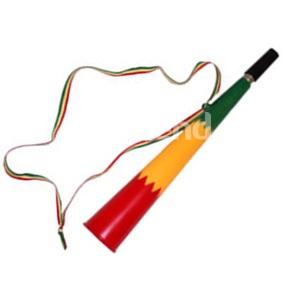
EH VUVUZELA! Vuvuzela Might Get Banned!!!

The loud,  sometimes obnoxious sometimes awesome Vuvuzela's might get banned from matches.. 

Could vuvuzelas fall silent? Ban possible

By Liz Clarke
Acknowledging a rising tide of complaints about the deafening din of vuvuzelas during World Cup matches, Danny Jordaan, chief executive of the tournament's local organizing committee, warned Sunday that the plastic horns could be banned if fans don't show more respect in their bugling.
In an interview with the BBC, Jordaan reiterated calls for fans not to blow vuvuzelas during the playing of a country's national anthem or during announcements over the soccer venues' public-address system. Asked if the horns could be banned, Jordaan said: "If there are grounds to do so, yes."
A ban on vuvuzelas was considered in the months leading up to the 2010 World Cup, but officials chose to allow them, with FIFA President Sepp Blatter arguing against efforts "to Europeanize" the first World Cup contested on African soil.
REST HERE


Get Your Own Vuvuzela on Ebay...

Saturday, June 12, 2010

Flashback 1988.....Gipsy Kings - Djobi Djoba

talk about a blast from the past....hard not to like the French-based group of Gitanos

Friday, June 11, 2010

Mexican Fans In South Africa

LOL count the national and cultural iconic symbols these five fans have crammed in.


its all there - Virgen De Guadalupe, Wrestler Mask, Charro Sombrero, Aztec Costume, Serape,Chapulin Colorado.   Outside of a Straw Sombrero a la Zapata or a Cantinflas costume, they seem to have done a comprehensive job.

from Univision -
El sueño mexicano se vivió así - Univision Futbol

Peru Inagurates Huge Natural Gas Export Plant, Bolivia Has Its Dignity

Peru's massive Liquid Natural Gas plant I talked aboout in an earlier post,  was just inagurated.  The project cost close to 4 billion dollars;  it is South America's first Natural Gas Liquification facility.  As Peruvian President Alan Garcia noted it is the "largest" "single project" ever made in Peru, as well as the largest foreign investment ever in the country.    The facility will receive gas from the Camisea gas fields, process and store it as LNG and ship in special tankers to customers overseas.    Though, there are doubts there is enough gas in Peru to sustain exports and meet national gas demands in the country, there is an increase in production and planned investments in the hydrocarbons sector to increase gas production.

video of Alan Garcia talking about how important this is.


Bolivia next door, actually has no issues with the size of its gas reserves.  But, it does not have investments necessary to raise production, much less the capacity in anyway shape or form to export LNG.  Its best chance to do that was through the Pacific LNG project that led to the infamous "gas wars".   But, the problem is that while Bolivia became the "Bermuda Triangle" of hydrocarbons in South America, both its neighbors and the industry as a whole have evolved.   Peru, Venezuela, and Brazil are seriously investing in producing LNG for export.  At the same time  Argentina, Brazil, Chile, and Uruguay are investing in regasification facilities to receive LNG shipments.   In other words countries with large markets for gas are looking at buying it off ships, instead of through pipelines - which was Bolivia's theoretical strength. 

Thursday, June 10, 2010

"Bolivia and Argentinas Gas Crisis Shakes South American Region"

Bolivia and Argentina's Gas Crisis Shakes Region,  according to Ana Zarzuela energy analyst at Spain-based  Intelligence and Capital News Report.

Basically, the idea of Bolivia as the "Gas Hub" first under the neoliberal governments, then with a more "statist" focus, called for Bolivian gas to be piped out to neighboring countries through pipelines.

But under Evo Morales, Bolivia has become an unreliable supplier.  The state-owned oil and gas company, can barely supply existing obligations, and production levels are stuck.  Most experts agree that the industry needs investments and know-how  from private and foreign companies.    Owing mostly to the governments attacks on private industry and judicial insecurity, this looks unlikely to happen.
  
While Bolivia has become an unreliable supplier of energy needs, neighboring countries have found other alternatives, including buying Liquid Natural Gas abroad and importing it via sea.   

The latest blow to Bolivian aspirations has to be Venezuela's PDVSA setting up regasification facilities in Argentina, that in coming years will process natural gas coming from....Chavez' Venezuela.    By, by, Bolivian gas.


Esta situación pone a Bolivia, que exporta sólo a través de ductos, en una posición muy distinta de hace cinco años, cuando se proyectaba como el centro de distribución regional. Se lo acaba de describir a Morales su propia Cámara de Hidrocarburos (CBH): detectan “un fuerte contraste entre el crecimiento del GNL en barcos metaneros a los centros de demanda de Sudamérica y el estancamiento de exportación de gas natural boliviano en gasoductos”. De la gran red que Hugo Chávez y Morales prometían tejer en toda Sudamérica con Argentina como punta de lanza, hoy no queda ni la intención diplomática. Las zozobras de La Paz y Buenos Aires, el pragmatismo de Caracas y los recelos de Brasilia, Santiago y Montevideo han podido más. “La apuesta por un proceso de integración por gasoductos, que tuvo un crecimiento explosivo en la capacidad de transporte internacional incorporada entre 1998 y 2002, de los 19,1 MMmcd a 105,8 MMmcd -advierte la CBH- ha llegado al estancamiento”. “El incumplimiento de contratos por parte de Argentina y Bolivia, el estancamiento de la inversión y la poca confiabilidad mostrada parecen haber postergado el apetito de los importadores regionales, para nuevos proyectos de integración intrarregional” por gasoductos, apunta la CBH.

Monday, May 24, 2010

Evo Opens A Gas Station!! *UPDATED 05/26/10


YPFB inauguró estación de servicio en Sucre
Lunes, 24 Mayo 2010
Sucre 24 mayo (AN-YPFB).- Con la presencia del Vicepresidente del Estado Plurinacional de Bolivia, Álvaro García Linera, Yacimientos Petrolíferos Fiscales Bolivianos (YPFB Corporación), inauguró...
 While Bolivia's Oil Company, YPFB can  barely drill a well anywhere in the territory, it celebrates the opening of a Gas Station in Sucre as a big deal, with the Vice President Alvaro Garcia Linera on hand.  That is funny-pathetic, from a company that last year spent more than $4 million USD in 2009 on marketing and advertising - as in publicizing its "successes" as pretty much campaign ads for Evo prior to the December elections.  On the other hand, its 2009 budget for job training for its 1400+ employees (only 26% of whom are oil and gas professionals) was a paltry $260,000. Instead it spends money on silly things like gas stations.

Mind you, building and running gas stations is expensive and not that profitable.   Gas stations that handle thousands of gallons of fuel, and are poorly run can be easy pickings for theft.     YPFB started getting out of that business about 18 years ago, due to the corruption and drain of resources itf was for the State.   Ask most Bolivians about the quantum leap in quality and service provided by private gas stations - from the ones the State ran, or for that matter from the ones it is running now.

EDIT -   Bolivian oil expert Carlos Miranda, has a good piece on what a disaster it is that YPFB is opening gas stations.   It can be seen as a new "nationalization" of the sector, since private stations will now have to compete with the state monopoly with sole control of fuel production and distribution.   Making matters worse is that Evo's government destroyed the regulatory agency, repsonsible for regulating the sector.

Estimado lector tengo dos noticias, una mala y la otra peor.    La mala. YPFB está retornado a la venta de combustibles al por menor. Para operar ha reparado estaciones de servicio y está construyendo nuevas.  Continuará con esta política hasta llegar al control de esa actividad. Así cerraría el círculo petrolero estatizante desde la exploración hasta la venta en surtidores.

La venta al detalle es una actividad totalmente boliviana. Pequeños empresarios que han invertido cerca de $us 200 millones y son dueños de más de cuatrocientas estaciones. Por eso el gobierno y YPFB han tenido un poco de pudor y no se animan a decir que las van a nacionalizar. 

YPFB no tiene memoria, no aprenden de sus dificultades y/o errores pasados.  Ventas al por menor, cuando no hacen ni dos meses ha tenido una estafa en la venta de carburantes en Santa Cruz, que ha provocado retiros de personal incluyendo nada menos que a un gerente comercial!

Cuando se creó YPFB el país se abastecía de refinados peruanos,  transportado por llamas y expendidos en ferreterías. Rápidamente YPFB substituyó las llamas con camiones cisternas plateados con el logo de YPFB e instaló los primeros surtidores. A partir de 1954 sólo vendían producción nacional que abastecía plenamente la demanda en calidad y cantidad. Por eso YPFB está en el alma de los bolivianos.

Para reducir costos y personal después, decidió alquilar sus instalaciones. Sindicatos y partidos políticos se abalanzaron vorazmente a las concesiones de surtidores.  Como YPFB era la única instancia para autorizar la construcción de estaciones de servicio, se convirtió en el centro del tráfico de influencias. La implantación del Sistema Regulatorio puso fin al festín de corrupción. La Superintendencia de Hidrocarburos se hizo cargo de la autorización y control de las estaciones de servicios. En esa forma ha logrado más de 400 estaciones de servicio en el país, muchas de ellas en al área rural,  todas prestando servicio las 24 horas del día.

Ahora YPFB quiere volver casi un siglo atrás poniendo y administrando instalaciones propias para competir con las estaciones privadas. Con el sistema regulatorio, casi inexistente que pueda impedirlo,  se viene una competencia desleal dirigida a que los propietarios vendan a YPFB sus instalaciones a precio de “gallina muerta” y así evitar “nacionalizar” inversiones bolivianas. Ejemplo,  lo que esta sucediendo con AeroSur y BoA.

Pobres nosotros los usuarios, lo que nos espera: mala atención, horarios irregulares, adulteración de productos, etc, etc.
   

Sunday, May 16, 2010

BOLIVIA - - Evo Morales' Industrialization Schemes FAIL, while Peru laughs all the way to the bank

Remember the Gas War? October, 2003, many Bolivians had a meltdown over a proposed 1.5 billion dollar project to export Liquid National Gas; a pipeline would send Bolivian gas to a new liquification plant and port complex to be built in Chile.   The outcry, in the context of a full mobilization by angry Cocaleros and disafection over economic recession (among many factors), ended with dead protestors and the forced ouster of the Constitutionally elected President.    Evo Morales a vociferous opponent of the project and guiding force behind many of the mobilizations that had paralyzed the country since 2000, was elected President in 05 to recover Bolivia's national resources from ugly multinationals, and to industrialize the mineral wealth of the country instead of exporting only raw materials.  

Build It And They Will....Nationalize It....

Evo, to the acclaim of some and the hope of many, signs a contract with Jindal Steel, a very large Indian Steel Company to mine an enormous iron ore deposit near the Brazilian border.      Jindal in a joint venture with the Bolivian State, agreed to invest over 2 billion dollars to not only mine the ore, but to build production facilities for steel and iron production.    Regardless of whether you like Evo or not,  it actually seemed at the time to be a win for Bolivia,.   The mineral rich Mutun, had been eyed for decades by past Bolivian governments for its potential, but nothing had gone through, now seemed as good a time as any.

Three years after the signing and approval of the whole deal.     The project is paralyzed, with Jindal ready to bail out.  Some of it seems to be due to Evo's dubious choices to run the Bolivian side of the deal, who were political appointees - labor leaders to be more precise.   Bolivia did not provide all the land (arguably it did provide most), but failed to build the roads needed and other infraestructure.   The company was supposed to invest at least 600 million, instead it spend about 20 million to build some offices, and to mine the ore for export as raw materials.   Morales' record of further "nationalizations" of foreign companies, constant rants against capitalism and the private sector, and the rather confusing Constitution might also have made the Indian conglomerate nervous, to the point where they would forfeit a 20 million dollar bond to get out of the deal.   Some common sense and direction, and the thing can probably be restarted, as of now its in limbo.


Where The Air Is Rarerified

While this entire process went from courtship to failure, in next-door Peru, a consortium to build a large LNG plant connected via a pipeline to Peru's largest gas fields, was taking shape.    It was started around the same time that Bolivia was having its massive meltdown over gas in 2003, the original concept was to be an alternative to Chilean ports for transporting Bolivian gas. But then it evolved more into exporting Peruvian production.    The project was approved and financed and the decision to go ahead was made in late 2006 - more or less while Evo was finalizing gthe deal with Jindal.

Well, as of April 2010, the full project - the largest single foreign investment in Peruvian history at close to $4 billion dollars - is almost ready.  The pipeline that runs through the Andes and desert is done, the docking facilities for the tankers and the processing plants and storage facilities are almost finished.    That is the speed with which private and public projects with backing, know-how, and leadership advance.    


Evo Cumplido

   Bolivians should take a look at what is being finished in Peru - they could have had something similar.  Arguably the Chile LNG plant would have been finished and exporting gas by now.   Ironically, the proposed project facilities in Chile - partly-owned by the Bolivian government - included a petrochemical facility.  It would have meant  Industrialization.  Bolivian natural gas used as raw material for Industrial goods.  Instead they have Evo whose four years in power have consisted of dramatic media spectacles like nationalization, constant political campaigning and propaganda, while living off the bounty produced by record world prices for things like hyrdrocarbons, in industries whose very existence is mostly due to the sectoral policies of  previous governments.

The Morales' governments socialist ideology and mania for centralization gives increasingly larger responsibilities for the State in the economy.   However, the only "nationalized"sector it runs well seems to be  mass media,  as it keeps on buying newspapers and other media to proselitize further.   What that media won't be reporting are things like the fact that in four  years of Evo's nationalized State Oil Company, YPFB, not one new discovery has been made,  only three wells were drilled last year (versus 64 in 2000, and more than 100 in Peru), and the country has to import gasoline for the first time in decades.   Blame a MAS government whose strident rhetoric and erratic behavior have chased away foreign investors.   A government that follows discredited economic policies,  places party-line over competence, values ideology more than technical or managerial know-how,  whose regulations have made its administration less transparent and accountable,  is prone to corruption, and is just plain inept.   To put it bluntly, it can't run a damn thing even with money in the bank. 

Evo's government takes it further; the MAS administration is incapable of even delegating and overseeing projects, where friendly investors do most of the actual work and spend most of the investment money.   Mutun is an example of four years of doing, absolutely nothing, except speeches about how great it is,   During that same time period the Peruvian government happily enabled a mega-consortium to build a huge export facility, port facility, and not to mention a large pipleine that crossed over mountains and deserts.  And that the project has spurred billions of dollars in investments in natural gas production, raising Peru's proven reserves - still nowhere near Bolivia's.   Considering the fact that at least one of the investors was involved in the Bolivia LNG project it is not farfetched to say that Peru LNG money originally was destined to be invested in  Bolivia, but ended up next-door, as have billions in exploration and production investments.   End score - Bolivia does not have a pipeline to the Pacific and a LNG processing plant and port on the Pacific, and neither does it have an operational steel plant making steel for domestic industry or export using Mutun iron ore.  Thats a lose-lose situation.

What could have been.?..

JON STEWART - CLASSIC DEMOLITION OF GLENN BECK ON HEALTHCARE

This is very, very good.   Glenn Beck as of 2008, complaining about healthcare - as in care he received while sick- in his usual crybaby fashion,. Then as of 2010, of course Obamacare is evil Jon Stewart on the Daily Show demolishes him.


thanks to My Favorite Jon Stewart PWNS

See Beck-tard get all personal in that piece... there is a method to his loony weepiness.
The crying conservative how Glenn Beck Taught His Feminine Side to Turn Tricks

Friday, May 14, 2010

Wrecking Venezuela - More From The Economist on Chavez

The unraveling of the Caracas Consensus continues unabated,


[President Hugo Chavez] threats against Colombia—which include a total trade embargo if Juan Manuel Santos, a former defence minister, wins this month’s presidential election—and the evidence of his veiled support for the FARC are troubling. They are a constant, if so far manageable, source of regional tension. And his efforts to build a block based on self-proclaimed “revolutions”, anti-Americanism and managed trade in the heart of democratic Latin America have served to undermine the very cause of regional integration that he claims to champion. But rhetoric aside, his influence in the region peaked a couple of years ago. He lost one ally, albeit in regrettable circumstances, when Honduras’s president, Manuel Zelaya, was overthrown last year. Several others are on the defensive.

Much more important is the damage Mr Chávez is doing to his own country. His “21st-century socialism” is a precarious construction. The brief fall in the oil price of 2008-09 was enough to sink Venezuela’s economy into stagflation—even as the rest of Latin America is enjoying vigorous economic recovery. Venezuelans are suffering declining real wages, persistent shortages of staple goods (meat is the latest to become scarce) and daily power cuts.

The blackouts are in part the result of drought. But they are also the most dramatic sign that the bill for a decade of mismanagement of the economy and of public services is now falling due (see article). There are plenty of other ugly portents. In one of the world’s biggest oil exporters hard currency is running short: to buy a dollar in the tolerated parallel market now requires almost twice as much local currency as the official exchange rate (and three times more than the privileged rate for “essential imports”). Investors rate the country’s debt as the riskiest of anywhere. Crime and corruption are flourishing.


Time to pay the piper Hugo

http://www.economist.com/displayStory.cfm?story_id=16109302

Thursday, May 13, 2010

The Economist - "Hugo Chávez's Venezuela Feeling the heat" Caracas Consensus Crashes

But for the time being the Bolivarian revolution (named after Simón Bolívar, South America’s independence hero) faces unprecedented difficulties. Everyday life is getting harder for Venezuelans. While the rest of Latin America is recovering strongly from the world recession, Venezuela is slumped in stagflation. The boom came to an abrupt end when the oil price plunged in the later months of 2008. Although it has since risen again strongly, Venezuela’s economy has not (see chart). Mr Chávez last month accepted that it “could” shrink again this year, confounding earlier official forecasts of growth. The IMF projects a contraction of Venezuela’s GDP of 2.6% this year, after a fall of 3.3% last year. By March, average wages (allowing for inflation) were 15% below their peak of 2007.

http://www.economist.com/displaystory.cfm?story_id=16104226

What’s in a BRIC? - Project Syndicate

Joseph Nye, argues that the BRIC acronym, "makes ilitte sense for long-term assessments of global power relations"  particularly when it comes to the R - as in Russia.

While a BRICs meeting may be convenient for coordinating some short-term diplomatic tactics, the term lumps together disparate countries that have deep divisions. It makes little sense to include Russia, a former superpower, with three developing economies. Of the four members, Russia has the smallest and most literate population and a much higher per capita income, but, more importantly, many observers believe that Russia is declining while the other three are rising in power resources.
Brazil in Nye's view does come across pretty well - 
 
Since curbing inflation and instituting market reforms in the 1990’s, Brazil has shown an impressive rate of economic growth in the range of 5%. With a territory nearly three times the size of India’s, 90% of its 200 million people literate, a $2 trillion GDP equivalent to Russia’s and per capita income of $10,000 (three times India’s and nearly twice China’s), Brazil has impressive power resources. In 2007, the discovery of massive offshore oil reserves promised to make Brazil a significant power in the energy arena as well.

Ultimately,  it will not become a "serious political organization"  of like-minded states" more like a group of countries that do well economically.

So, how seriously should analysts take the term BRIC? As an indicator of economic opportunity, they should welcome it, though it would make more sense if Indonesia replaced Russia. In political terms, China, India, and Russia are competitors for power in Asia, and Brazil and India have been hurt by China’s undervalued currency. Thus, BRIC is not likely to become a serious political organization of like-minded states.
What’s in a BRIC? - Project SyndicatePosted using ShareThis