Sunday, December 27, 2009

Bolivia y su política en materia de hidrocarburos

Bolivia y su política en materia de hidrocarburos
Lunes, 14 Diciembre 2009
2009-12-14 07:59:55 Por Emilio J. Cárdenas Ex embajador de la República Argentina ante las Naciones Unidas - Evo Morales, como era previsible, acaba de ser re-electo como Presidente de Bolivia....


En 2006 Bolivia tenía autoabastecimiento de naftas e importaba un 30% de su diesel. Hoy la última cifra es del orden del 50% del consumo doméstico. Además, el año que viene se perderá la autosuficiencia que Bolivia lograra en 1954. No será nada fácil recuperarla. Se estima que tomará unos cinco años de hacer bien las cosas y unos 8.000 millones de dólares de una inversión que será difícil de obtener desde que pocos, muy pocos, confían en Bolivia. En rigor, ni los maltratados brasileños. Bolivia no ha reinvertido en el sector en el último quinquenio y las consecuencias estarán –muy pronto– a la vista de todos. En el futuro inmediato, Bolivia deberá importar el 20% de sus naftas y el 20% de su gas licuado. Porque lo cierto es que es poco, muy poco, lo que ha hecho el Estado en el sector. Entre el 2002 y el 2006 se perforaron 96 pozos. En los 4 últimos años, solamente 18. De horror como fracaso de gestión. Inocultable, por demás.

Top Gear goes to Bolivia!


Top Gear goes to Bolivia! BBC's Top Gear, IMHO the planets best car show goes to Bolivia - As in previous episodes, the trio of Jeremy Clarkson, James May, and Richard Hammond are given a set of tasks. First off they buy cars - sight unseen - on the internet, off local websites. They then hit the Altiplano, salt flats, and the La Paz-Coroico road (aka road of death) most definitvely looks to be fun...

Tuesday, December 22, 2009

Gas could be the cavalry in global warming fight

Pointing to Natural Gas as a clean (relatively speaking) form of energy. See if a re-elected Evo gets with the program and stops destroying Bolivia's natural gas industry


[N]atural gas, the same fossil fuel that was in such short supply a decade ago that it was deemed unreliable. It's now being uncovered at such a rapid pace that its price is near a seven-year low. Long used to heat half the nation's homes, it's becoming the fuel of choice when building new power plants. Someday, it may win wider acceptance as a replacement for gasoline in our cars and trucks.


If the market is increasing for natural gas in the US - and with new discoveries, that opens the gates for US production - as well as LNG depending on the price.


Energy experts believe that the huge volume of supply now will ease price swings and supply worries.

Gas now trades on futures markets for about $5.50 per 1,000 cubic feet. While that's up from a recent low of $2.41 in September as the recession reduced demand and storage caverns filled to overflowing, it's less than half what it was in the summer of 2008 when oil prices surged close to $150 a barrel.

Oil and gas prices trends have since diverged, due to the recession and the growing realization of just how much gas has been discovered in the last three years. That's thanks to the introduction of horizontal drilling technology that has unlocked stunning amounts of gas in what were before off-limits shale formations. Estimates of total gas reserves have jumped 58 percent from 2004 to 2008, giving the U.S. a 90-year supply at the current usage rate of about 23 trillion cubic feet per year.

Thursday, October 29, 2009

Colombia - FARC control and infiltrations of some labor unions

Colombian blogger Rafael Guarin, publishes his "revealing interview done in 2007" with the secretary of a leading agricultural Union, Fensuagro.

Turns out that Juan Efrain Mendoza was captured by the Colombian Army in a raid on a FARC camp.


Una inédita y reveladora entrevista que le fuera hecha en el 2007 al secretario de Fensuagro, Juan Efraín Mendoza, capturado por el Ejército en un campamento en Sumapaz, muestra lo que las Farc busca conseguir en el campo político.*

Tratándose de un dirigente sindical, muchos se sorprendieron de su captura en combates contra las Farc. No fue mi caso. La entrevista que le hice a Juan Efraín Mendoza revelaba una inquietante cercanía con la organización guerrillera y el papel que Fensuagro cumple.


Read the original here.


Basically Mendoza is either an infiltrated, clandestine FARC member, or a complete useful idiot from his rhetoric.

No surprise there, the FARC and its predecessors, as good Leninists have always had front groups, and had infiltrated other organizations - gaining effective control of some. It was always Jacobo Arenas' strategy to use different forms of "mass struggle" to complement the armed insurgency.

Sometimes, the FARC would tip its hand when it was trying to infiltrate Unions, causing dissension within Union ranks - and often involving violence. Not surprisingly, this often resulted in paramilitary reprisals, escalating general violence further.

The bottom line of this whole situation is that, yes, there are some Unions in Colombia where the FARC wields its invisible hand.

Wednesday, October 07, 2009

US Policy Towards Latin America - Populism and The Rise Of The Center

---Interesting paper circulating among government officials, think tanks, academics about Latin America populism and implications for US policy.


Dealing with Political Ferment in Latin America: The Populist Revival, the Emergence of the Center, and Implications for U.S. Policy

, Dr. Hal Brands. esearcher at the Institute for Defense Analyses

Can be read in full here


The current political dynamics in Latin America is analyzed, and their meaning for the United States is evaluated. The author argues that references to a uniform “left turn” in the region are misleading, and that Latin America is actually witnessing a dynamic competition between two very different forms of governance. Represented by leaders like Hugo Chávez, Evo Morales, and others, radical populism emphasizes the politics of grievance and a penchant for extreme solutions. Moderate, centrist governance can be found in countries like Chile, Brazil, Mexico, Colombia, and Uruguay. It stresses diplomatic pragmatism, the protection of democratic practices, and the need to blend macroeconomic responsibility with a social conscience. To the extent that the United States can strengthen the centrists while limiting the damage caused by radical populism, the author argues it can promote integral growth, democratic stability, and effective security cooperation in Latin America. A clear understanding of the trends discussed is essential to devising appropriate U.S. policies toward that region.

Friday, October 02, 2009

Cuba's Own Craigslist


Local papaer, Miami Times article Cuba's black market moves online with Revolico-com talks about the emerging internet marketplace in Havana. Taking the online classifieds concept pioneered by Craigslist to country with an onerous command economy, and very likely making it even more obsolete.

The article describes Mateo a home mechanics experience

One of his three kids, 23-year-old Manuel, wanted to join some friends on a trip to the north coast. For months, father and son tried to unload some expensive rims to raise money. Though Manuel thought they were worth 300 pesos — about $325 — no one was biting.

"Dad," Manuel finally said, "have you heard about Revolico?"

Revolico? In Cuban slang, it means "a mess." Mateo had no idea what his boy was talking about.

So Manuel took his father to the house of a friend, an engineer with spotty Internet access at home. They logged onto revolico.com and discovered a capitalist Valhalla. There was everything for sale: cars, tires, motorcycles, diapers, cell phones, laptops, massages, Chinese lessons.

Sunday, September 27, 2009

Bolivia, Mil Millones De Dolares De Regalo Para Yacimientos

La navidad de YPFB
Viernes, 25 Septiembre 2009
2009-09-25 08:02:33 Carlos Miranda Pacheco* Hace días la navidad llegó a YPFB con un espléndido regalo que se lo denominó préstamo. Mil millones de dólares, a 20 años plazo con el 1% de...

Tuesday, September 08, 2009

Interesting article - Racial Resentment, Authoritarianism and Health Care Reform

Interesting argument by professor Jonathan Weiler, backed by data.


In the just-published book that I have co-authored with Marc Hetherington, Authoritarianism and Polarization in American Politics, we argue that how Americans view political issues and establish partisan attachments is being increasingly driven by gut-level world views, which is best characterized by the term authoritarianism. Since levels of authoritarianism are powerful predictors of individuals' views on the hot button issues of the day like gay rights, immigration, and torture, they now explain whether people choose to be Republicans and Democrats, which is a key reason why our politics have become so rancorous and impervious to reasoned conciliation.


Weiler concludes:


In sum, there is reason to think that beneath the arguments about government intrusion into the health care market, death panels, and such, a much more visceral dynamic is at work. To be perfectly clear, it is far from the case that every opponent or skeptic of significant health-care reform is a racist or racially motivated in her or his thinking. But there is, at the least, very strong circumstantial evidence that views of race and beliefs about health care reform are linked significantly among many Americans, which probably explains why the debate on health care reform has caused a much stronger uproar in 2009 than it did in 1994.

Monday, August 31, 2009

ALL YOUR BASE ARE BELONG TO..... - Chavez Hypocritical posturing


Talk about arming a big brouhaha........Hugo Chavez complaining of US intervention, specifically the treaty to use Colombian bases.

The socialist leader called Colombia’s plan to host more U.S. soldiers a “hostile act” and a “true threat” to Venezuela and its leftist allies. He warned that a possible U.S. buildup could lead to the “start of a war in South America

WHAT A HYPOCRITE......GIVE ME A BREAK!


shall we start with a couple of basics?


His invitation to Russia to "send ships, refuel long-range bombers and temporarily station anti-submarine aircraft in Venezuela", including the much publicized exercise held almost exactly a year ago with key parts of the Russian fleet


"Venezuela is a strategic ally of Russia. So let the Russian fleet come. It's welcome,"


Ummm..so Chavez basically invites a extra-territorial nuclear power to sail its main battle fleet into his waters, and says he welcomes them stationing personnel in Venezuelan bases.

Not to mention that Russia is the power selling sophisticated weapons to Chavez' dis-functional and corrupt military. This fuels a regional arms race. What is the purpose of all that offensive materiel? Venezuela has no real internal or external military threats - unlike Colombia which faces a ruthless insurgency that until recently controlled a lot of territory.

The most troubling part of Chavez arms buildup regardless of its origins, is that some of these weapons (i.e. shoulder-held Surface to Air Missles) can make it to Colombia, through coca-dollars or ideological sympathy. And Colombia is a country which does face an existential threat, the FARC.

The only "hostile" “true threat" to his neighbors is Chavez.

Thursday, August 13, 2009

Bernie Madoff, How did he do it?

for anyone puzzled about the Bernie Madoff ripoff, this Economist article and the NYT article on Bernie sidekick Frank DiPascali presents some basic info on key aspects of the scams. A complex Ponzi scheme, covered by loads of fake info cleverly designed to appear as legitimate trades.


Mr DiPascali was the main point of contact for investors, who ranged from Jewish charities to film moguls. He also oversaw the mechanics of the vast Ponzi scheme. It purported to be making steady, double-digit returns trading options on a share index. In fact, client funds sat in an account at JPMorgan Chase and were withdrawn only to meet redemptions or to be parked in Treasuries and the like. This was “nothing more than a slush fund”, according to the complaint against Mr DiPascali by the Securities and Exchange Commission.

Though there was no actual trading, the conspirators were far from idle. They cooked up phantom trading records, client confirmations and account statements to corroborate the fictitious investment strategy. They made thousands of wire transfers between the firm’s London and New York offices to make it look like it was earning commissions from real transactions.

Monday, August 10, 2009

Newsweek Says Latin America "Swings" Rightward

Interesting article in Newsweek Latin America Swings Right Not Left


First off, I am not so sure that there is anywhere near a general "shift" to the center and/or right in that very broad and generic "general" Latin American electorate as this article suggests.

But I do agree with the articles contention that the "Washington Consensus" approach is very much alive in many of the principal countries of Latin America. I have been saying that for a long time. Fact of the matter is that countries which are better off like Colombia, Peru, Chile and Brazil have continued policies that favor trade, fiscal responsibility, macroeconomic stability, foreign investment, private sector dynamism, and are much more succesfull than "Caracas Consensus" countries.

In the new Latin America, party affiliation and ideological inheritance may be heartfelt, but they are lousy compasses to the political future. And while neoliberalism and the Washington Consensus may be still be maldiciones below the Rio Grande, they are hardly dead or even out of fashion. In fact, with the exception of Mexico—whose fortunes are tethered to the faltering U.S. market—the nations faring best in the global financial downturn are those that have hewed closest to the free-market reforms that have proved so politically provocative. If onetime left-wingers are in charge in a dozen Central and South American states, most remain leftists in name only.

Thursday, July 23, 2009

President Obama's Speech to Africa

What Obama said in Ghana will resonate for a long time with not only that continents people, but also with people all over the developing world. It is also very consistent with what he said to the NAACP.
In the end the themes he raised about the culture of corruption, failure, and blaming the west for every wrong is a message that should be heeded in Latin America. The old/new leftist agenda (Chavez), besides being bankrupt ideologicially, subsists on churning out propaganda that fosters a culture of blaming others for its own failures.

Wednesday, July 08, 2009

POWER, CORRUPTION & LIES- Bolivia follow blackout Venezuela

Evo Morales publically "nationalized" the energy companies in Bolivia on May 1st, forcing private investors and worker cooperatives to sell their ownership shares of jointly owned companies.   So the state assumes total ownership and management control over the production, transportation, and sales of power that these companies held, constituting 80 percent of the sector in Bolivia, with a few regional cooperatives outside State hands.  What in fact was a mixed-model of ownership is now becoming a solely state-run system.

By looking around the region, there is no more striking contrast as that presented by the energy policies and results of Colombia and Venezuela, which illustrates why Bolivia will likely end up in failure.

A Tale of Two Countries -

According to the CIA factsheets for Colombia and Venezuela, the neighboring countries are roughly around the same size, Colombia about a sixth bigger, and with more people 43.6m to 26.8 m, (est).. But, Venezuela with 17 million less people has almost double the GNP of its neighbor. ($353.5 billion 2009 est.vs. 228.6 billion) and has a higher per capital income $13,200 vs. $9,200 . Government revenue is roughly par, with Venezuela's government spending about 15 percent more ( $92.04 billion vs. 79 billion).

 "In 2008" Venezuela "was the eighth-largest net oil exporter in the world"; a petroleum powerhouse that co-founded OPEC and . Colombia may have a more diversified economy but it doesn't have the Orinoco oil belt or Lake Maracaibo in its territory. Historically, high oil prices mean Venezuelans are on the average richer than their more populated neighbors - in fact sometimes Venezuelan income levels have been first world - in the 50's the country had a GNP close to West Germany's. Venezuelas government can afford to spend much more per capita on its citizens than Colombia on infraestructure and social programs.

Venezuela not only has oil and gas to spare, and money, but it has a vast hydsroelectric potential (think monster rivers w/big elevation changes) and major infraestructure in place.he  Guri Dam Complex on the Caroni River, known officially as the Central Hidroeléctrica Simón Bolívar, one of the 3 largest hydroelectric plants in the world, either 2 or 3 behind Brazil's Itupi and China's Three Gorges Dam. Planning for the complex started under dictator Perez Jimenez, and the first stages were completed in the early 60's.

So with this kind of riches and government spending, why in the world is the electric power grid in Venezuela dangerously close to collapsing, threatening the country's future growth.


Blame it on El Niño, the climatic phenomenon that is causing a drought in that part of South America. Lower water levels in the rivers that drive generators means less power.


With this going on, you'd expect next-door Colombia also suffering the drought to be going through a similar energy crisis - Bogota and Medellin sharing Caracas-style blackouts.

Not the case by a mile, if anything Colombia has excess capacity it has offered to sell to Venezuela.

Sin embargo, El Niño no golpea con la misma fuerza a todos los países, pese a que los déficits de agua que produce son similares. Mientras en Ecuador y Venezuela los apagones de hasta ocho horas diarias empezaron a convertirse en cotidianos durante los meses de enero y febrero, en Colombia el país logró mantener sus luces encendidas, incluso con capacidad de sobra que podría vender a sus países vecinos


First of, Venezuelans of all classes, have benefited enormously from the oil boom, and they have more money to spend. That has driven demand for power way up. If you are poor and you suddenly are able to afford things like refrigerators, TV's, air conditioners, you buy them. Middle class folks, all the sudden can afford more goodies, TV's. Tony restaurants, night clubs, and fancy shopping malls spring up to cater to the new and old rich and they all use up power. That happens in an oil boom, and it has happened in Venezuela before in the 70's and again the early 90's.

El Nino, like an oil boom is cyclical, and comes through Venezuela.

And the chaotic response has included Chavez' emergency rolling blackouts, importing Castro's former-Interior Minister to advise on the crisis, government prayer meetings for rain, buying huge turbines from US Multi-National General Electric,

El caso de Venezuela es paradójico, pues se trata de un país prodigiosamente rico en recursos energéticos. No sólo cuenta con las consabidas enormes reservas de hidrocarburos. Además, tiene la segunda hidroeléctrica más grande del mundo después de Itaipú. Se trata de Guri, una represa que tiene una capacidad de 10 millones de kilovatios/hora, equivalente a 300.000 barriles diarios de petróleo, la que sólo es una de tantas represas del río Caroni, todas administradas por Electrificación del Caroni (Edelca).

lo inexorable en la situación energética no es el clima, sino la realización o no de inversiones adecuadas.

El Niñoes también una dura prueba para las matrices energéticas de los países andinos..


Lo que representa Edelca no es menor, pues la compañía abastece 70% de la demanda eléctrica, por lo que su incapacidad de generar energía frente a un fenómeno climático no habitual es síntoma de la ausencia de inversiones con las que planificar contingencias como ésta.

Actualmente Venezuela tiene una capacidad instalada de 23.642 mw, según informó el mismo presidente Hugo Chávez, una cifra que plantea oficialmente el ambicioso desafío de generar 10.000 nuevos mw en cinco años, amén de reducir drásticamente la demanda.

“Somos muy derrochadores, los que más gastamos electricidad en América Latina”, ha dicho Chávez. Pero la voluptuosidad del consumo venezolano es sólo una parte pequeña del problema. “En 11 años el gobierno sólo ha logrado incrementar la capacidad en 3.200 mw”, dice Guillermo Ovalles, ex presidente de la empresa transmisora de energía Elecentro y actual presidente de la comisión de energía eléctrica de la Federación de Cámaras y Asociaciones de Comercio y Producción de Venezuela.


meanwhile Colombia has adequate energy supplies, despite being twice the size and having half of the budget of Venezuela.  (not to mention 10's of thousands of crazies waging war on the state - and for control of drug routes) 

En Colombia Después del colapso energético de 1993, las autoridades empezaron a trabajar en un parque de generación eléctrica de bases hídrica y térmica. Gracias a esas inversiones, el país hoy tiene una capacidad instalada de 13.800 mw (53% proveído por plantas térmicas y 47% por hidroeléctricas). Una diversificación de la matriz eléctrica notable, más si se considera que en el reciente 2008 las plantas hidroeléctricas respondían por el 80%.


Hoy Colombia está iniciando su programa de ampliación del parque energético entre los años 2010 y 2018, mediante el cual desarrollará nueve proyectos, la mayoría de los cuales entrará a operar antes de 2015. Las inversiones sumarán más de US$ 6.000 millones y adicionarán 3.421 mw al sistema nacional.

This is what you get with sensible policies

Friday, July 03, 2009

La Palin Resigns


Sarah Palin just announced she is resigning as governor of Alaska, running for President in 2012?


Todd S. Purdum’s excellent Vanity Fair piece , It Came from Wasilla,, detailing La Palin's doings in Alaska and in the McCain campaign. that has Democrats laughing, Republicans fighting among themselves, and Independents glad that one of the most brainless of American politicians in recent memory is not a heartbeat away from the presidency.

She apparently didn’t like preparing for debates back then either. “In the campaign for governor, they’re prepping her for debate,” Curtis Smith’s former business partner, Jim Lottsfeldt, told me recently in Anchorage, “and Curtis says, ‘The debate prep’s going horribly. Every time we try to help her with an answer, she just gets mad.’” (Smith himself says, “Unfortunately, I don’t recall having that exact conversation with Mr. Lottsfeldt, nor do I recall my experience, including debate prep, with Governor Palin in the light he portrayed.”) But Palin’s lack of knowledge turned out not to hurt her. Andrew Halcro later remembered that he and Palin once compared notes about their many encounters, and she said, “Andrew, I watch you at these debates with no notes, no papers, and yet when asked questions, you spout off facts, figures, and policies, and I’m amazed. But then I look out into the audience and I ask myself, Does any of this really matter?”

Thursday, July 02, 2009

MILLER: End Of The Tony George Era


Tony George's reign at the Indianapolis Motor Speedway is over after leaving the sport divided after forming the IRL and locking out CART in 96.
Robin Miller tells it right:
MILLER: End Of The Tony George Era

Shared via AddThis

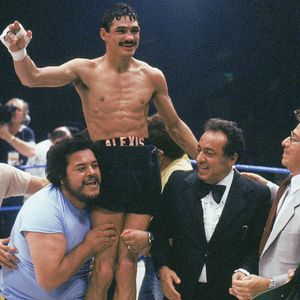
Alexis Arguello, Nicaraguan 3-Time World Boxing Champ Dead


DAMN, this is a real bummer. I grew up watching Alexis' fights. "El Flaco Explosivo" was a national hero in Nicaragua and the whole country would shut down when he fought. Before the era of a bewildering number of "world championships" boxing had two sanctioning bodies which crowned a world champion for each weight class. Alexis won 3 separate titles. a major feat.

Alexis Arguello dies
.....from ESPN


MANAGUA, Nicaragua -- Alexis Arguello, who fought in one of boxing's most classic brawls and reigned supreme at 130 pounds, was found dead at his home early Wednesday.

Coroners were conducting an autopsy to determine the cause of death. Sandanista Party's Radio Ya and other local media were reporting it appeared to be a suicide.

[+] EnlargeAlexis Arguello
Getty ImagesAlexis Arguello was found dead Wednesday at 57. He is pictured in June 1981 after beating Jim Watt to win the WBC lightweight title.

The La Prensa newspaper reported that Arguello -- elected mayor of Nicaragua's capital last year -- was found with a gunshot wound to the chest.

The 57-year-old Arguello retired in 1995 with a record of 82-8 and 65 knockouts and was a champion in three weight divisions. He was perhaps best known for two thrilling battles with Aaron Pryor and fights with Ray Mancini, Bobby Chacon and Ruben Olivares.

"I'm kind of in a daze right now," Pryor told The Associated Press. "Those were great fights we had. This was a great champion."

Nicknamed "The Explosive Thin Man," Arguello was inducted in 1992 into the International Boxing Hall of Fame, where flags were flying at half-staff in his honor Wednesday.

Hundreds of people lined up to say goodbye to Arguello Wednesday night at a memorial service at the Palace of Culture in the capital of Nicaragua.


pic/ ESPN/Getty

Tuesday, June 30, 2009

Bolivia: Coca Es Mostly Cocaina.....Cocaine Production Up In Bolivia & Peru Down in Colombia


According to Reuters

LIMA (Reuters) - Cocaine production is growing fastest in Bolivia while Peru is on its way to matching output from Colombia, the top global producer of the drug, U.N. officials said on Friday.

Coca plant cultivation in Bolivia, which expelled U.S. anti-drug agents last year after accusing them of meddling in domestic affairs, grew 6 percent in 2008, according to the U.N. Office on Drugs and Crime's annual study of Andean nations.

Estimated cocaine production rose 9 percent to 113 metric tons in the impoverished South American nation.


This is what happens when you leave the fox in charge of the henhouse. The reality that Evo-pologists avoid or ignore is that Morales's main base of support is composed of people who grow coca that is almost exclusively used to make cocaine. They want to be able to avoid annoyances like the DEA so they can grow coca freely so they can sell it or make their own coca paste. So now it is easier to do such things as bribe cops/military people without the "gringos" there, and there is less incentive to do anything about it.

EDIT

Meanwhile, the UN also found that production also increased in Peru, part which can be attributed to neo-Sendero Luminoso types. Meanwhile growing of coca and production of cocaine actually fell in Colombia. Part of this might have to do with successes against the FARC, who both directly control some of the production and export as well as critical smuggling routes. And also moving against top Paramilitary leaders, who often acted with semi-sanction from officials because they fought the FARC. Critical in the Colombian conflict(s) and efforts against traffickers is territory. The more space in control or disputed by non-governmental armed bands, the more space that could be used to grow and produce cocaine. In a larger sense the conflicts with the guerillas also acted as a buffer against government actions against all parties dealing cocaine. Taking those players out of the equation allowed both direct erradication - as well as for traditional law enforcement to work against drug dealer.

Monday, June 29, 2009

Honduras Flies The Coup UPDATED


Poor Zelaya received an old-fashioned military coup d' etat, subject to wide condemnation. And the man is hardly a Chavez/Evo, at the very worst a very mild-wannabee. More to the point he is the Constitutional, freely-elected President of the Republic of Honduras, whose term has not ended. Military leaders arresting him and sending him to exile is just plain simply a coup d' etat. Too old-school and scary.

Funny that Cuba - a one-party totalitarian government for 50 yrs is protesting very loudly. As is Chavez who celebrates his own failed (and bloody)coup attempt in 1992 to this day. Ditto for Evo Morales who agitated and conspired actively to bring down two Constitutional Presidents in Bolivia, and who pretty much ignores parliamentary and legal niceties.
El mandatario venezolano, Hugo Chávez, quien al igual que Cuba venía advirtiendo sobre la posibilidad de un golpe de Estado en el país centroamericano desde hace días, fue uno de los primeros en salir en defensa de Zelaya. Chávez anunció una ´batalla continental´ a favor de la restitución de su homólogo.

En ese sentido, los medios de comunicación reportaron el desarrollo de una reunión extraordinaria de presidentes de la Alba en Managua, que empezó anoche con la presencia de Venezuela, Ecuador, Nicaragua y Cuba, y a la que hoy se sumará Bolivia.


EDIT

President Obama made the right moves and set a good tone:


WASHINGTON (AP) — Dealing with the first Latin American crisis of his presidency, Barack Obama sought a swift, clear response that would not be interpreted as U.S. interventionism in a region that loathes it.

So he condemned a coup in Honduras by turning to the most reliable of friends: democracy.

"We stand on the side of democracy, sovereignty and self-determination," Obama said when asked Monday about the forced exile of Honduran President Manuel Zelaya, a takeover that has drawn international criticism and unnerved a part of the world that has worked to shed itself of strong-arm tactics.

The point could not be lost. Obama mentioned some version of the word democracy eight times. He even wound up referring to George Washington.

The response put Obama with much of the world as Honduras and its newly appointed leader, Roberto Micheletti, quickly found themselves isolated. Obama left sticky underlying issues in Honduras for its people to decide, but pledged that the U.S. would work with international bodies on a peaceful solution.


As the NYT reports countries "ideologically" divided, as diverse as Bolivia and Colombia have condemned the coup. Specially worth noting is the reactions of
Argentina, Brazil and Chile, the 70's "gorilla" countries.
Boz has four posts and analysis here, 2, 3, 4.

Here is the OAS declaration which Boz cites:

1. To condemn vehemently the coup d’état staged this morning against the constitutionally-established Government of Honduras, and the arbitrary detention and expulsion from the country of the constitutional president José Manuel Zelaya Rosales, which has produced an unconstitutional alteration of the democratic order.

2. To demand the immediate, safe and unconditional return of President José Manuel Zelaya Rosales to his constitutional functions.

3. To declare that no government arising from this unconstitutional interruption will be recognized.

Saturday, June 27, 2009

Bolivia Stalls On Negotiating With Obama Administration Over Trade Preferences

Latest news from Bolivia's Foreign Ministry is that it has "postponed" sending a delegation to Washington DC to negotiate the possibility of Bolivia renewing trade preferences under the Andean Trade Preferences act. Suspended by the Bush admninistration in part due to Morales expulsion of the US ambassador and the DEA, the door had opened under Obama.

The program started in 1992 and took off slowly before picking up after 2002. In 2006 and 2007 exports to the US were 172.1 million and 153.3 million. Textiles were a big part. It is a very large percentage of Bolivia's total manufacturing exports. One estimate is that it produces 26,132 jobs directly and 17,541 indirect jobs for a total of 43,670.


Why this isn't a priority for Morales' government? Could be ideological disdain both for the private sector actors and the US. More to the point, loudly trumpeting Chavez' ALBA..as well as punishing business owners opposed to his rule. Or also could be that there is one group of private sector exporters and producers that Morales is heeding. The ones who don't want the DEA poking in their business anymore.

Bolivia - No More High Court

Bolivia's Constitutional Court basically ceased to exist as the last Judge has resigned. The Court, which has jurisidiction to be the ultimate arbitrer regarding the Constitutionality of laws, has been esentially dead the last couple of years.

An undereported story internationally, is how Evo Morales' government has waged a war on the highest two Courts in the land, the Supreme Court and this Court. The executive, has brought the equivalent of sanction and/or impeachment proceedings in the legislature against individual Judge, who have resigned. For the past couple of years that has meant a failure to get a quorum of judges to hear issues that have come up over the changes occuring in society.